
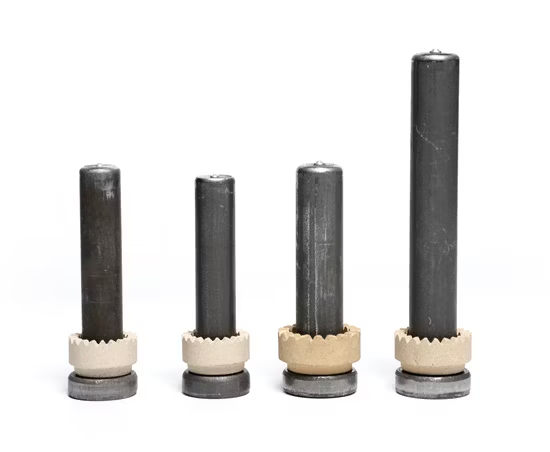
Shear Stud Prices and Factors Determining Prices
What Is a Shear Stud and Where Is It Used?
A shear stud (headed stud) is a fastener that is joined to a steel surface using the stud welding method and provides composite behavior after concrete pouring. The most common applications include:
- Bridge and viaduct projects
- Steel decks (deck + concrete systems)
- Industrial facility platforms
- Silos and refineries
- Structural reinforcement projects
Due to this wide range of applications, shear stud prices are a direct factor affecting project costs.
How Are Shear Stud Prices Determined?
The following sections provide a clear explanation of the key factors that influence shear stud prices.
1. Steel Grade and Material Class
Shear studs are typically manufactured from alloy steels such as C45, 20MnB4, and 34CrNiMo6. As the steel grade increases:
- Impact resistance increases
- Welding stability improves
- Cost increases
EN ISO 13918 standardına uygun, sertifikalı stud çivileri, standart ürünlere göre genellikle %20–35 daha pahalıdır. Bu nedenle “stud çivisi fiyatı neye göre değişiyor?” sorusunun ilk yanıtı malzeme kalitesidir.

2. Diameter and Length (Φ ve L)
One of the most important factors determining the price of a stud is its dimensions.
The most common stud diameters:
- Φ13
- Φ16
- Φ19
- Φ22
As the diameter increases, the amount of raw material and production time also increase.
Example price relationship:
Örnek fiyat ilişkisi:
- Φ16 → reference price
- Φ19 → +35–50%
- Φ22 → +80–100%
Similarly, as the length increases, the price rises almost in direct proportion to the weight.
3. Kaplama (Galvaniz, Fosfat, Shot-Blast)
Another factor affecting shear stud prices is surface treatment.
The most common types of coating:
- Hot-dip galvanizing
- Electrogalvanizing
- Phosphating
- Shot-blasting surface cleaning
Kaplama gerektiren ürünler genellikle %10–25 daha pahalıdır. Açık hava köprüleri veya ağır sanayi tesislerinde galvanizli stud şartnameyle zorunlu olabilir.
4. Production Method: Cold Forming vs. Hot Forging
Shear studs are produced using two different methods:
Cold Forming
- Faster production
- Cost-effective
- Preferred for standard projects
Hot Forging
- Higher strength
- Mandatory for critical projects
- Maliyet, soğuk şekillendirmeye göre %20–30 daha yüksektir
Therefore, the answer to the question “Why are hot-forged stud nails more expensive?” lies in both raw material consumption and processing costs.
5. Certificates, Test Reports, and Quality Documents
The following documents are required for large-scale projects:
- EN 10204 3.1 or 3.2 certificate
- Ultrasonic test report
- Chemical analysis
- CE certificate
- Mechanical test reports
Sertifikalı ürünler ek kalite süreçlerinden geçtiği için fiyat %25–40 artabilir.
6. Ferrule (Welding Ceramic) and Accessory Costs
The ferrules, gun tips, and adapters used in the stud welding process affect the total cost. In particular, ferrule costs can account for up to 5–10% of the stud cost, especially in high-volume applications.
7. Order Quantity and Production Lead Time
Prices drop significantly for bulk purchases.
- 5,000 units → standard price
- 20,000 units → 10–15% discount
- 50,000 units → 20% discount
Acil üretim talepleri için üreticiler %10–20 ek fiyat uygulayabilir.
8. Exchange Rates and the Steel Market
Shear stud prices in Turkey fluctuate largely depending on economic factors such as:
- The USD/TRY exchange rate
- Steel raw material prices
- Global prices of alloying elements
.
Conclusion: There Are Numerous Factors Affecting Shear Stud Prices
Shear stud prices vary depending on many factors, such as steel quality, dimensions, coating, production method, certification requirements, and market conditions. To ensure the most accurate pricing for a specific project, the technical specifications and intended application must be clearly defined.
Selecting the right stud nails ensures: longer service life, higher strength, safer composite structures.
.
More Information
With our specially designed production line for shear stud production, we manufacture 150,000 shear studs per month in compliance with TS EN ISO 13918 standards. In addition to standard shear studs in sizes ranging from 50mm to 250mm in lengths and diameters of 16, 19, 22, and 25, we also offer custom production for customer projects in lengths such as 60, 90, 110, and 220 mm. For more detailed information about shear studs and applications tailored to your needs, please contact us.