

What Does Shear Stud Do? Usage Areas, Quantity Calculation and Choosing the Right Product
1. In What Types of Construction Are Shear Studs Used?
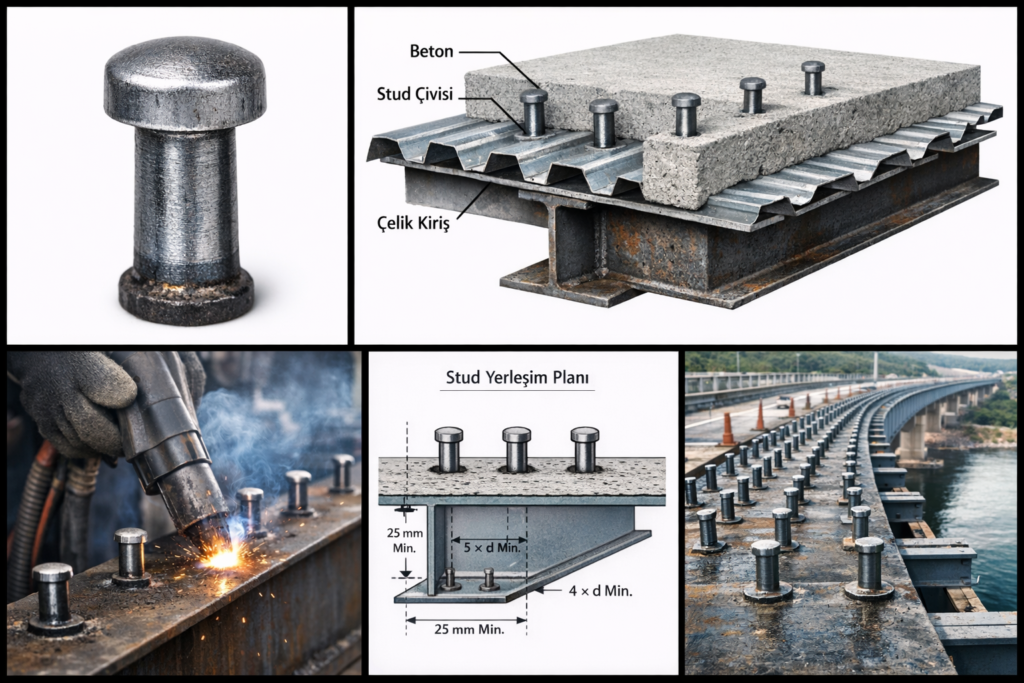
Shear studs are used in many different types of structures and provide distinct structural benefits in each:
 Composite Slabs
Steel Bridges
Industrial Floors and Machine Foundations
Prefabricated Elements
How Many Shear Studs Are Used per Square Meter?
Standards do not specify a fixed value per square meter. The quantity is determined entirely based on structural calculations, load values, and beam spacing. However, typical values commonly encountered on-site are as follows:
- In composite floors: approximately 3–6 per square meter
- In industrial floors under heavy loads: 8–12 per m²
- In bridge decks: much denser spacing may be required depending on the loading conditions
The exact number is calculated based on the shear force requirement (V_Ed) and the stud design resistance (P_Rd).
3. How Are Shear Stud Dimensions Determined in Structural Analysis?
a) Stud Resistance
b) Spacing and Placement Rules
Eurocode 4 defines limits for stud-to-stud and stud-to-beam edge distances. These limits:
- serve to prevent concrete cracking
- and ensure the safe performance of the concrete cone around the stud.
amacına hizmet eder.
c) Selection of Stud Height
Eurocode does not specify a fixed minimum embedment ratio (e.g., 10×diameter) for stud height. Instead, it is mandatory to ensure sufficient concrete coverage below the stud head and to meet the criteria for profiled floor height and fire resistance.
In practice, stud height is determined by the following factors:
- Deck (sheet metal) height
- Required concrete cover
- Minimum embedment distance required for the stud head
- Minimum concrete thickness for fire resistance
Summary: Shear stud height is determined based on the effective height required by the design; there is no fixed, codified multiplier.
4. What Should You Consider When Purchasing Shear Studs?
Choosing the right product is critical for structural safety. The following points should be considered during the purchasing process:
Certification and Compliance with Standards
- Compliance with EN ISO 13918 (standard for headed studs)
- Certificate of compatibility with welding equipment
- CE marking and material certificates
Material Quality
High-quality steels such as S235JR and S355J2 are typically used. Manufacturer certificates must be reviewed.
Welding Compatibility
Shear studs must be fully compatible with resistance welding machines. If the weld is of poor quality, proper fusion will not occur.
Corrosion Environment
Galvanized studs should be preferred for open-air or bridge structures.
5. What Happens If Inappropriate Shear Studs or an Insufficient Number of Shear Studs Are Used?
Incorrect selection or installation can lead to serious structural problems:
 Composite behavior is compromised
Concrete and steel cannot work together; floor deflections increase, and cracking accelerates.
Risk of stud failure or buckling
Stud breakage may occur under fatigue conditions.
Insufficient shear transfer
The slab begins to slip on the steel beam; irreversible deformations develop over the long term.
Risk of rejection by building inspection
Errors in shear stud quantity or placement rules may result in the entire construction having to be redone.
Conclusion
To summarize the answer to the question “What is the purpose of a shear stud?”: Shear studs play a critical role in both the safety and load-bearing capacity of composite structures. The quantity and dimensions must be determined through static calculations in accordance with Eurocode 4, and certified products must be used on-site. An incorrectly selected stud bolt or improper installation creates both structural risks and high costs.
More Information
With our specially designed production line for shear stud production, we manufacture 150,000 shear studs per month in compliance with TS EN ISO 13918 standards. In addition to standard shear studs in sizes ranging from 50mm to 250mm in lengths and diameters of 16, 19, 22, and 25, we also offer custom production for customer projects in lengths such as 60, 90, 110, and 220 mm. For more detailed information about shear studs and applications tailored to your needs, please contact us.